Thou Shalt Not Kill
The sixth commandment, "Thou Shalt Not Kill", does make sense to me. I am yet to know of a single advantage to deliberately setting out to kill someone, the want or perceived need to murder. To be clear, I am not addressing manslaughter in this post.
I understand that a desire to murder may be present in some. It may be considered necessary as an act of revenge, an attempt to gain power or to remove a threat. In all cases, I feel that the killing is selfish, hypocritical, undemocratic and unjustified. Essentially you do become morally bankrupt when you resort to murder. You become as morally bankrupt as those who murder.
Consider murder as revenge for terrorism. When the September 11 attacks occurred in America, there was a significant loss of life. The perpetrators were murderers. Innocent victims were murdered by ideological violence. No matter the violence, or the number of deaths, how can murder of the perpetrators be justified? I know that it probably feels good to some to know that the perpetrator is now dead, removed from the physical world and no longer a threat, but why is it the right thing to murder in retaliation of murder? This is especially troubling when America often holds itself up as the bastion of Christianity in the West. The same Christianity that espouses, "Thou Shalt Not Kill". The same Christians that cheered upon hearing of the death of Osama Bin Laden and Saddam Hussein. Again, why was/is it right to murder in retaliation for murder?
One would assume that atheists would be prime candidates for this type of moral bankruptcy. Atheists don't believe in God and I suppose, by extension, probably don't follow the Bible. An atheist without morals grounded in the Bible would surely be a killing and raping machine. However, history shows that disgusting acts of violence, rape and murder are not isolated to atheists. Surprisingly, the moral arbiters of our world, Christians, are soaked in violence, rape and murder. Some sources report that a large majority of prison inmates are aligned with Christianity. Sure, with a large population of Christians in America, you might expect a correlated percentage, but seemingly, the good book and the associated moral fibre don't go hand in hand.
When it comes to crime in general, I feel that the "Forgiveness Escape Clause" plays a major role. Commit the crime, pray for forgiveness, absolve your responsibility and escape negative judgement in the next life. Secular law seems to be the only mechanism that does not forgive and for good reason.
For more heinous actions such as murder, capital punishment and an eye for an eye, I sense a little blood lust and a power trip. I sense that those groups and individuals backed by religious dogma, feel that they are doing the work of God. Christians, doing the work of God, in contradiction to central tenants of the Bible. Amazingly, George Bush received a message from God regarding Iraq - God told George Bush to end the tyranny in Iraq. This, of course, had nothing to do with "Invading Iraq" being in the family DNA.
Next, let us observe the actions of Texas Governor, Rick Perry, an Evangelical Christian. Governor Rick Perry holds the record on the number of death row executions in America. Why? "Thou Shalt Not Kill" need not apply here. Never mind that innocents may be put to death. Never mind those pesky rules in the Bible. Just assume the role of your God on earth and fulfil your desire for justice by means of murder.
Disturbingly, during a recent conversation I had, one fellow was able to justify his adherence to the rule of "Thou Shalt Not Kill" by explaining that they, themselves, had not killed. This is bizarre and shows a moral disconnect between the support of killing and the actual killing. Therefore supporting the death penalty for prisoners, is not killing. Maybe this is how Governor Rick Perry adheres to "Thou Shalt Not Kill". Governor Rick Perry only signs the documents authorising the killing. Some other individual controls the injection, the gun or the noose. In other news, eating animals that you have not killed yourself, is also not considered killing.
The hypocrisy doesn't end here. Recently it seems fashionable to denigrate atheists in the military. Apparently there are no atheists in foxholes. A pitiful attempt at making atheists seem like cowards who are not mentally or physically tough enough to fight the good fight in battle. To be good enough for war, to fight for your country, to invade another country for it's oil, you need God on your side. You need to be a Christian. You need to be a Christian warrior for God. Who does all of the killing in war? "Thou Shalt Not Kill" seems to only apply when it suits. Personal gain, lust for power, also known as, "What A Christian Wants", will always trump biblical adherence.
I feel that adherence to the Bible is a facade. Adherence to the teachings of the Bible is essentially optional. The facade is at it's most powerful when a Christian wants something, desires something. Invoking the invisible and undetectable God for their purpose, gives them the green light. Murder and crime are sure to happen, with God on the Christians side.
Murder overseen and sponsored by the Christian God is perfectly reasonable in the moral mindset of a Christian. Forgiveness will be granted. It is Gods will. It is a Christians will. Thinking that any of the commandments, or the Bible, make a shred of difference to Christian actions and/or morality, is absurd.
Sunday, July 14, 2013


Tuesday, May 8, 2012
Evidence Is Not Needed For Fairy Tales
Evidence Is Not Needed For Fairy Tales
Theists are always so sure about the existence of god. God exists because I feel it it my heart. God exists because the Bible says it is so. God exists because the world looks designed especially for us. I believe it, therefore it is true, and all my religious club members are correct. God exists.
From my perspective, I can't see, feel, hear or sense any such god. So naturally I ask for some evidence to prove that god exists. Hundreds of years into the advancement of the scientific method and no empirical evidence has yet to be found that confirms any such existence. Most of the bogus stories of the Bible, which at some point were taken as literally true, have been disproven by science or explained by natural processes. Talking snakes and living inside whales may be the only exceptions.
I've had discussions with theists that basically amount to them concluding that we don't need evidence for god and that's why it is called faith. Oh, and by the way, you can't prove that god doesn't exist. Pathetic really.
Consider these compressed conversations as a summary :
Conversation 1
Theist : I believe in God.
Atheist : There is no evidence or proof for god therefore I don't believe in god.
Theist : You can't prove there isn't a God therefore God exists.
Conversation 2
Atheist : Your pastor/priest is a pedophile.
Theist : No he isn't. You don't have any proof that my pastor is a pedophile.
Atheist : You can't prove that he isn't therefore your pastor is a pedophile.
Typically, funnily enough, theists require evidence for positions that portray a negative consequence for their preconceived ideas. In the above examples, god existing is a positive assertion and requires no evidence. Your pastor/priest being a pedophile has negative consequences and requires evidence.
We see exactly the same behaviour when a theist denies evolution. Typically a theist will reject evolution as being incomplete in it's evidence or in a display of total intellectual disconnect, they will put forward the "evolution is only a theory" position. A sudden need to reject an idea that has negative consequences for their own beliefs.
The acceptance of evolution basically means the entire Adam and Eve story is bogus (as there was no Adam and Eve) and therefore no need to be saved and therefore no need for Jesus and therefore no reason to push Christian fables on society.
For entertainment purposes, as much as denying evolution is intellectually shallow, I think I prefer theists to try and mix reality with religion. For example, much like George Pell on Australian Q&A performing the equivalent of Nadia Comaneci gymnastics in regards to the story of Adam and Eve. Note to George Pell, know something about evolution when debating an evolutionary biologist.
It really is just too easy to ask why theists can't just accept evolution without evidence, like they accept god without evidence. I suppose a theist has probably been told their whole life that such and such is true. I can only imagine the mental anguish when they discover it is probably all false. A defensive mechanism kicks in to protect their fragile need to be right.
One of the most beautiful things about science and the scientific method, is that they have provided mechanisms that enable you to prove and also to falsify or refute the assertions of evolution. If you deny evolution and have scientific facts to back it up, your notoriety will be eternal in the undoing of hundreds of years of scientifically proven work. However, onward we march. The evidence for evolution continues to stack up. No know refutation of the empirical, factual evidence has been found.
I forgot to add that the same methods that have been used to provide all of the technical breakthroughs we take for granted every day, are the same checks and balances, the same peer review processes and the same experimental processes that have been utilised to prove evolution. We aren't walking around denying our computers exist.
I now ask, where is the evidence for god? What system can I use to refute the assertion that there is a god? Easy to answer. There is no evidence and there is no system of refutation. Mr Hitchens said it best, "What can be asserted without evidence can also be dismissed without evidence!".
Claiming there is a god without providing evidence and then using misdirection and completely bogus arguments against evolution, which actually has evidence, is completely absurd.
Theists are always so sure about the existence of god. God exists because I feel it it my heart. God exists because the Bible says it is so. God exists because the world looks designed especially for us. I believe it, therefore it is true, and all my religious club members are correct. God exists.
From my perspective, I can't see, feel, hear or sense any such god. So naturally I ask for some evidence to prove that god exists. Hundreds of years into the advancement of the scientific method and no empirical evidence has yet to be found that confirms any such existence. Most of the bogus stories of the Bible, which at some point were taken as literally true, have been disproven by science or explained by natural processes. Talking snakes and living inside whales may be the only exceptions.
I've had discussions with theists that basically amount to them concluding that we don't need evidence for god and that's why it is called faith. Oh, and by the way, you can't prove that god doesn't exist. Pathetic really.
Consider these compressed conversations as a summary :
Conversation 1
Theist : I believe in God.
Atheist : There is no evidence or proof for god therefore I don't believe in god.
Theist : You can't prove there isn't a God therefore God exists.
Conversation 2
Atheist : Your pastor/priest is a pedophile.
Theist : No he isn't. You don't have any proof that my pastor is a pedophile.
Atheist : You can't prove that he isn't therefore your pastor is a pedophile.
Typically, funnily enough, theists require evidence for positions that portray a negative consequence for their preconceived ideas. In the above examples, god existing is a positive assertion and requires no evidence. Your pastor/priest being a pedophile has negative consequences and requires evidence.
We see exactly the same behaviour when a theist denies evolution. Typically a theist will reject evolution as being incomplete in it's evidence or in a display of total intellectual disconnect, they will put forward the "evolution is only a theory" position. A sudden need to reject an idea that has negative consequences for their own beliefs.
The acceptance of evolution basically means the entire Adam and Eve story is bogus (as there was no Adam and Eve) and therefore no need to be saved and therefore no need for Jesus and therefore no reason to push Christian fables on society.
For entertainment purposes, as much as denying evolution is intellectually shallow, I think I prefer theists to try and mix reality with religion. For example, much like George Pell on Australian Q&A performing the equivalent of Nadia Comaneci gymnastics in regards to the story of Adam and Eve. Note to George Pell, know something about evolution when debating an evolutionary biologist.
It really is just too easy to ask why theists can't just accept evolution without evidence, like they accept god without evidence. I suppose a theist has probably been told their whole life that such and such is true. I can only imagine the mental anguish when they discover it is probably all false. A defensive mechanism kicks in to protect their fragile need to be right.
One of the most beautiful things about science and the scientific method, is that they have provided mechanisms that enable you to prove and also to falsify or refute the assertions of evolution. If you deny evolution and have scientific facts to back it up, your notoriety will be eternal in the undoing of hundreds of years of scientifically proven work. However, onward we march. The evidence for evolution continues to stack up. No know refutation of the empirical, factual evidence has been found.
I forgot to add that the same methods that have been used to provide all of the technical breakthroughs we take for granted every day, are the same checks and balances, the same peer review processes and the same experimental processes that have been utilised to prove evolution. We aren't walking around denying our computers exist.
I now ask, where is the evidence for god? What system can I use to refute the assertion that there is a god? Easy to answer. There is no evidence and there is no system of refutation. Mr Hitchens said it best, "What can be asserted without evidence can also be dismissed without evidence!".
Claiming there is a god without providing evidence and then using misdirection and completely bogus arguments against evolution, which actually has evidence, is completely absurd.
Sunday, May 6, 2012
Join The Club
Join The Club
Fringe ideas have always been out there. The original thoughts that may go against the grain of the established ideology. The ideas that may challenge us and our society to the very core.
 In my current frame of reference I see religion and factory farming as two key ideologies that are out there and currently being scrutinised by a litany of original thoughts and fringe ideas. Ideologies that are being challenged to the core. Ideologies that should be challenged to the core.
Without my degree in psychology to understand, I have encountered what I would call "ideological protection mechanisms" when confronting the ideas of religion and factory farming. A bit like the robbery shields in a bank. An internal button is pressed and *whack*, up comes an intellectual shield that is impervious to damage (YouTube - Megadeth - Psychotron). Those people who close the gates to any notion of their religion or their dietary choices being challenged or questioned.
More interestingly, if your choices or opinions don't match theirs, they feel a deep sense of vilification. A pain so bad they are close to violence trying to suppress their rage. "You won't discuss religion in my house again", they say. What is this reaction of rage? The loving, patient Christian and their god motivated rage. Other reactions may include repetitive and childish bullying. Is this just insecurity?
Last I checked, the decisions and ideas of others, unless they are imposed on me, are still only their decisions and ideas. If you choose to believe in god and choose to eat meat, good on you. If I choose to not believe in god and to be a vegetarian, when exactly does this become your problem? Maybe I will eat all of the salad and not participate in grace when I am a guest in your house? Not sure.
 I get the feeling that these people have walked down the same path so many times, that they just can't change or are scared to hear an opinion of opposition. In reality though, I have found this isn't always true. It seems that football, politics and outcast relatives are all fodder for discussion. In my mind, anything in the public arena should be fair game. Why should religion get a free pass? Why should I ignore the horrors of factory farming and "just eat meat"?
I have heard the saying that you don't discussion religion and politics with people. This really is a terrible shame as it is so true. It seems we can now add animal ethics to this ban. Suppose a society that didn't challenge all ideas. Back to the caves people. The end of innovation and progress as we know it.
 What is one to do? Should I just join all of the biggest clubs? Go with the majority. Go with the mob. Choose positions and ideas that allow me to just exist and become an invisible part of the pack. Buy the same, eat the same, believe in the same god, reject individualism and conform. Club Christian or Club Dead Animal anyone? No thanks.
A world where everyone conforms and is part of the same club sounds boring. However, I accept that some people are so insecure in their own opinions that they don't want to talk about them.
One thing is for sure, given questions that attack my core morals and opinions, it would be intellectually stunting to simply deflect the questions. I see that blindly accepting a position, when someone can quite obviously point out a failing in your reasoning, is dishonest. I can understand how a child or young mind may innocently fall victim to this way of thinking, but an adult has no excuse.
It is so obvious that the rejection or blacklisting of fringe ideas and questioning, as a method to protect your indefensible intellectual positions, is absurd.
Fringe ideas have always been out there. The original thoughts that may go against the grain of the established ideology. The ideas that may challenge us and our society to the very core.
 In my current frame of reference I see religion and factory farming as two key ideologies that are out there and currently being scrutinised by a litany of original thoughts and fringe ideas. Ideologies that are being challenged to the core. Ideologies that should be challenged to the core.
Without my degree in psychology to understand, I have encountered what I would call "ideological protection mechanisms" when confronting the ideas of religion and factory farming. A bit like the robbery shields in a bank. An internal button is pressed and *whack*, up comes an intellectual shield that is impervious to damage (YouTube - Megadeth - Psychotron). Those people who close the gates to any notion of their religion or their dietary choices being challenged or questioned.
More interestingly, if your choices or opinions don't match theirs, they feel a deep sense of vilification. A pain so bad they are close to violence trying to suppress their rage. "You won't discuss religion in my house again", they say. What is this reaction of rage? The loving, patient Christian and their god motivated rage. Other reactions may include repetitive and childish bullying. Is this just insecurity?
Last I checked, the decisions and ideas of others, unless they are imposed on me, are still only their decisions and ideas. If you choose to believe in god and choose to eat meat, good on you. If I choose to not believe in god and to be a vegetarian, when exactly does this become your problem? Maybe I will eat all of the salad and not participate in grace when I am a guest in your house? Not sure.
 I get the feeling that these people have walked down the same path so many times, that they just can't change or are scared to hear an opinion of opposition. In reality though, I have found this isn't always true. It seems that football, politics and outcast relatives are all fodder for discussion. In my mind, anything in the public arena should be fair game. Why should religion get a free pass? Why should I ignore the horrors of factory farming and "just eat meat"?
I have heard the saying that you don't discussion religion and politics with people. This really is a terrible shame as it is so true. It seems we can now add animal ethics to this ban. Suppose a society that didn't challenge all ideas. Back to the caves people. The end of innovation and progress as we know it.
 What is one to do? Should I just join all of the biggest clubs? Go with the majority. Go with the mob. Choose positions and ideas that allow me to just exist and become an invisible part of the pack. Buy the same, eat the same, believe in the same god, reject individualism and conform. Club Christian or Club Dead Animal anyone? No thanks.
A world where everyone conforms and is part of the same club sounds boring. However, I accept that some people are so insecure in their own opinions that they don't want to talk about them.
One thing is for sure, given questions that attack my core morals and opinions, it would be intellectually stunting to simply deflect the questions. I see that blindly accepting a position, when someone can quite obviously point out a failing in your reasoning, is dishonest. I can understand how a child or young mind may innocently fall victim to this way of thinking, but an adult has no excuse.
It is so obvious that the rejection or blacklisting of fringe ideas and questioning, as a method to protect your indefensible intellectual positions, is absurd.
Tuesday, April 10, 2012
No Holidays For You
No Holidays For You
Easter is another good time to witness first hand the bombardment of Christian culture on Australian society. It is inescapable and pervasive.
As a non-believer, I have been challenged by theists to justify why I take part in Easter celebrations. Typically this involves the particularly banal and pathetic statement that I should be working on the public holidays dedicated to Easter celebrations.
Straight up I will admit that I don't want to take part in Easter celebrations. Especially in the religious sense. I feel that the whole Jesus story is bogus, disgusting and not worthy of any celebration.
The idea that an innocent person was punished for the crimes of humanity is disgusting. I say it again, an innocent person, tortured and murdered, for the crimes of others. I've said it publicly, it makes no sense. Imagine a modern justice system that decrees the allocation of punishment to the innocent on behalf of the guilty.
Never mind the related story of a the same guy rising from the dead, leaving his tomb empty and visiting people in a zombie like fashion. At this point, the kitchen sink of impossibilities can be thrown into the equation and as with most religious stories, evidence and common sense are the last things that cross your mind. A supernatural being is obviously the only explanation for what occurred. Obviously.
God could have invoked flood version 2 and savagely and heartlessly drowned the vast majority of plants and animals, including us, to death. Maybe life rafts and food reserves would appear for the believers and the sin free. Another option is to smite the ungodly masses using a Godly lightning bolt to the head. Instead, God chose a bizarre and brutal crucifixion ceremony with a twist at the end.
So why do I take part in Easter celebrations? In my mind, I don't. In body, it is the social, family and cultural pressure. People react poorly when their baseless beliefs are questioned (I will post more on this later). Basically, I could be doing something more productive than spoiling their day of mythical worship, which means I will miss out on that glorious opportunity to be lambasted by those loving, compassionate, tolerant Christian types. All of the pressure aside, people know how I feel, I just don't bring it up.
Actually, most of what we do on Easter these days isn't even of Christian origin but has been co-opted by Christians to boost the popularity. Rabbits and chocolate eggs? What have they got to do with Jesus?
Now, right back to the start to address the public holiday question. Do Liberal voters get to take the Labour Day holiday (See: Australian Labour Movement). Do non-citizens deserve to take the Australia Day holiday? Can republican thinkers take the Queens Birthday public holiday?
All of these holidays can discriminate by means of their meaning or origin, but the state, who determines public holidays, does not discriminate. Good luck to the religious if they attempt to oppress and exclude participation in Easter based on religious affiliation. It would be relevance suicide on a grand scale.
To be true to the holiday, I do make an effort to at least think about the meaning and origin of Easter. Unfortunately, I didn't get the opportunity to read the Bible, which I usually do on religious days. I also didn't get the opportunity to read anti-religion publications such as God Is Not Great. Instead, I was lucky enough to watch Richard Dawkins and George Pell on Q & A. The entire hour simply acted to re-enforce the worming and weaving that religion and in particular the institutions of religion have to do to justify themselves.
One dimensional arguments from cultural non-practicing Christians are pathetic. The biggest objection you have against my Atheism around Easter is that I shouldn't be able to take the day off?
Take a good look at yourselves and your beliefs. Grown adults, believing a story that is thousands of years old, disgusting at it's core. Unproven, improbable, poorly represented by those who hold the highest chairs and most importantly, absurd.
Tuesday, February 28, 2012
Jumping To The Positive

Mention something bad about religion or something terrible in the bible and very often the religiously inclined will unleash what I would call "religious fanboyism". A defensive reflex designed to immediately wave away any negativity on the subject and quickly exclaim, "but it does so much good!".
This seems to be fairly common in life as well, but staying on the topic of religion, people generally defend their religion with positive assertions, ignore those bad parts of the bible, or deliberately choose to be ignorant.

With this idea of positive assertion and positive defense in mind, think about the resurgence of bogus arguments against abortion coming from religious groups. The most famous being the Beethoven argument. Apparently, abortion should be banned just in case the baby you aborted turns out to be Beethoven. The religious objection to abortion is only bathed in positive outcomes.
 |
| Ludwig van Beethoven |
Strangely, if Beethoven didn't exist, we would not have known it to be the case. The second greatest musical composer would now become the greatest music composer and so on. Beethoven may have been born but what if he had died in his infancy instead of his other siblings. Imagine all of the worlds greatest that have died due to religious conflict around the world. The next Beethoven could also be the child that just died in Africa from starvation or an unfertilized egg. We just won't know.
This is where the argument of positive association and assertion raises it's head again. Using absolute hindsight, knowing that Beethoven is an accomplished and famous composer, this huge plus for our society could have been lost if we allowed abortion.
 |
| Adolf Hitler |
With this hindsight firmly in view, flip the coin and apply the same argument to Hitler. Would abortion be okay if it was Hitler who was going to be aborted? Simply banning abortion does not guarantee a positive outcome. Humour me here and allow my baseless positive association and imagine how many brilliant Jewish scientists with intelligence, double that of Einstein, would have existed if Hitler had been aborted.
It is presented like an all or nothing proposition but the assertions are false. As are the three statements below :
- If Beethoven was aborted, we would never have known good music.
- If Einstein was aborted, we would never have discovered relativity.
- If Hitler was aborted, we would have avoided terrible religious and ethnic cleansing.
Hindsight is always 20/20 and leaping towards positive assertions and associations in an attempt to bolster your religiously motivated opinions on abortion is baseless. The rights of women to own their bodies and their own decisions is a far more amicable pursuit and any opposition to this, especially from a religious perspective, is absurd!
Wednesday, February 15, 2012
Why Grieve?
Why Grieve?
I am coming into a time in my life where my relatives, friends and colleagues are losing their much loved and cherished parents and grandparents. It is sad, I feel for them and I too will be facing these difficult times myself in the future.
The funeral services I have attended have had religious content. I hope I have shown no disrespect to the lives of the individuals by not reciting the prayers with the group. I see no reason to participate as I do not believe that the individual is headed towards a kingdom in the sky. In my opinion, the kingdom in the sky does not exist and the guardian of the kingdom is simply a fairy tale.
The general content of these prayers is about the safe passage of the soul of the individual into the kingdom in the sky, and that the guardian helps them on their way. Assuming the soul has a safe passage and isn't held up by road works, the soul is now in the company of previously passed relatives peering down on the physical earth. In a religious context, this is the happiest place to be, eternally.
Given this idea of eternal happiness, why do believers grieve when a loved one dies?
As a non-believer, I grieve as I know I will never interact with that person again. Their voice, their touch, their presence. This person no longer lives, but as one celebrant said, "Out of sight, should not be out of mind". I still have memories and hear stories about this person. I remember them and I remember their legacy. In a sense, a non-believer experiences a true loss as there is no reunion, ever.
I would imagine that if I truly believed in spiritual reunions with loved ones passed, and they were enjoying eternal happiness, then I would be feeling an overwhelming sense of happiness for this individual. Maybe in a fit of jealousy, I would be upset that I wasn't there to enjoy it as well.
In the context of eternity, the time that passes during our earthly lives is irrelevant. Compare infinity to 1 if you like. Now consider the time between successive generations passing on. Such a short time and it's not that long until, as a believer, you rejoin your loved ones passed, in happiness, and do so for eternity.
So why do believers grieve when it is such a temporary situation? I suspect they know deep down that the idea of a kingdom in the sky is absurd and they essentially experience exactly the same true loss that a non-believer experiences.
I am coming into a time in my life where my relatives, friends and colleagues are losing their much loved and cherished parents and grandparents. It is sad, I feel for them and I too will be facing these difficult times myself in the future.
The funeral services I have attended have had religious content. I hope I have shown no disrespect to the lives of the individuals by not reciting the prayers with the group. I see no reason to participate as I do not believe that the individual is headed towards a kingdom in the sky. In my opinion, the kingdom in the sky does not exist and the guardian of the kingdom is simply a fairy tale.
The general content of these prayers is about the safe passage of the soul of the individual into the kingdom in the sky, and that the guardian helps them on their way. Assuming the soul has a safe passage and isn't held up by road works, the soul is now in the company of previously passed relatives peering down on the physical earth. In a religious context, this is the happiest place to be, eternally.
Given this idea of eternal happiness, why do believers grieve when a loved one dies?
As a non-believer, I grieve as I know I will never interact with that person again. Their voice, their touch, their presence. This person no longer lives, but as one celebrant said, "Out of sight, should not be out of mind". I still have memories and hear stories about this person. I remember them and I remember their legacy. In a sense, a non-believer experiences a true loss as there is no reunion, ever.
I would imagine that if I truly believed in spiritual reunions with loved ones passed, and they were enjoying eternal happiness, then I would be feeling an overwhelming sense of happiness for this individual. Maybe in a fit of jealousy, I would be upset that I wasn't there to enjoy it as well.
In the context of eternity, the time that passes during our earthly lives is irrelevant. Compare infinity to 1 if you like. Now consider the time between successive generations passing on. Such a short time and it's not that long until, as a believer, you rejoin your loved ones passed, in happiness, and do so for eternity.
So why do believers grieve when it is such a temporary situation? I suspect they know deep down that the idea of a kingdom in the sky is absurd and they essentially experience exactly the same true loss that a non-believer experiences.
Wednesday, January 4, 2012
Hearing Voices
Hearing Voices
As an atheist, if I announced that god had spoken to me, I would be similarly labelled. Skeptics would immediately have doubt and rightly expect proof. Theists would easily dismiss my claims, after all, I am not part of their specific cult. Potentially I could ask them to have faith? Everyone else would think I was crazy. "Line him up for the loony bin", they say. Maybe I am not credible enough, and easily dismissed?
I was witness to a conversation recently. A number of people were sitting around a table talking about a deeply religious person who apparently heard the voice of god, as god was speaking to her. Maybe this is not that unusual in religious circles, but the "crazy" label was mentioned quite a number of times.
As an atheist, if I announced that god had spoken to me, I would be similarly labelled. Skeptics would immediately have doubt and rightly expect proof. Theists would easily dismiss my claims, after all, I am not part of their specific cult. Potentially I could ask them to have faith? Everyone else would think I was crazy. "Line him up for the loony bin", they say. Maybe I am not credible enough, and easily dismissed?
Imagine the impact if god spoke to devout atheists like Richard Dawkins, Sam Harris and Christopher Hitchens (sadly passed). A true hurdle of skepticism would have to be overcome before they accepted this. At every moment they would be analyzing and asking why this is happening, much like the doctor experiencing a stroke. Maybe they would even ask the right questions of god in return. On second thoughts, most people think that people who speak to god, are crazy. There would be no benefit, only the loss of credibility for the atheist, who would refrain from mentioning it. It wouldn't make sense for god to talk to an atheist.
It also wouldn't make sense for god to talk to a theist. The marketing has already been done. The theist is already on board, drinking religious coca-cola, merrily participating, hearing the tales of the word of god through the congregation or by reading the biblical mystery box. The mission to spread the word of god to this individual wouldn't require direct spoken contact. Oh, and I repeat, most people think that people who speak to god, are crazy.
This idea of craziness is diluted somewhat if you are higher up in a religious hierarchy or order of importance. It is almost as if the collective delusion makes the issue go away and the support becomes stronger. The pope could explain the he had heard from god and this would be generally accepted by the collective. The president of the US could explain that he heard from god and then use god as the validation to invade IRAQ with support from the people.
 Back to reality, we know that god talks more to people in power, loves talking to crazy people and almost exclusively talks to theists.
A recent presidential candidate in the US explained that god told them to run for president. The exact same desire they have paced over, prayed over and discussed with friends and family, is affirmed by god. Also recall my previous comment regarding the use of god to validate the invasion of IRAQ. This is now heading to the upper levels of self delusion.
Unfortunately, in the aftermath, god had a plan and the presidential candidate was smashed in recent voting counts and subsequently pulled out of the presidential race. god got it very wrong, works in mysterious ways and probably hasn't offered an explanation for why such a crappy recommendation was made. The IRAQ war fared even worse.
I agree with the sentiments of the people around the table. People who say that god speaks to them, are crazy. Irrespective of religious affiliation or non-affiliation. god only speaks to people in works of fiction. The idea that god speaks to people in reality, is just absurd.
It also wouldn't make sense for god to talk to a theist. The marketing has already been done. The theist is already on board, drinking religious coca-cola, merrily participating, hearing the tales of the word of god through the congregation or by reading the biblical mystery box. The mission to spread the word of god to this individual wouldn't require direct spoken contact. Oh, and I repeat, most people think that people who speak to god, are crazy.
This idea of craziness is diluted somewhat if you are higher up in a religious hierarchy or order of importance. It is almost as if the collective delusion makes the issue go away and the support becomes stronger. The pope could explain the he had heard from god and this would be generally accepted by the collective. The president of the US could explain that he heard from god and then use god as the validation to invade IRAQ with support from the people.
 Back to reality, we know that god talks more to people in power, loves talking to crazy people and almost exclusively talks to theists.
A recent presidential candidate in the US explained that god told them to run for president. The exact same desire they have paced over, prayed over and discussed with friends and family, is affirmed by god. Also recall my previous comment regarding the use of god to validate the invasion of IRAQ. This is now heading to the upper levels of self delusion.
Unfortunately, in the aftermath, god had a plan and the presidential candidate was smashed in recent voting counts and subsequently pulled out of the presidential race. god got it very wrong, works in mysterious ways and probably hasn't offered an explanation for why such a crappy recommendation was made. The IRAQ war fared even worse.
I agree with the sentiments of the people around the table. People who say that god speaks to them, are crazy. Irrespective of religious affiliation or non-affiliation. god only speaks to people in works of fiction. The idea that god speaks to people in reality, is just absurd.
Sunday, December 18, 2011
Knowing What Is Morally Right
Knowing What Is Morally Right
Leviticus 18:22 : You shall not lie with a man as with a woman; it is an abomination.
Much of my disdain for religion comes from the age old problem of theists using the bible to persecute, marginalize, discriminate and spread hate towards others. In the free world, the bible is used as a sledgehammer to oppress minority groups and in particular those who are lesbian, gay, bisexual and/or transgender (LGBT).
Two passages spring to mind, but there are others :
The vulgar book is fairly clear, but is this all we have to know what is morally right in this situation? No.
Frankly, I've never really concerned myself with the sexuality or sexual orientation of others. Recently though, I have come to understand that sexual orientation is not a choice. I don't remember making a decision to be a heterosexual, I just am. I am sure others didn't choose to not be heterosexual aka gay. Nobody in their right mind would consciously choose anything other than heterosexuality, especially considering the shallow and pathetic discrimination shown by society, and in particular, the religiously minded. I will say it again, nobody chooses.
Given that I know people that are lesbians and I know people that are gay, do I judge these people as abominations after reading a single passage, from a single book? No, and to do so, would be absurd.
Even without discussing the characters of these individuals, the contributions they make to our society, the churches they attend, the love they give to their families and the love they give to their consensual adult partners. I would still say no. Concluding someone as an abomination without knowing their character and their life is ludicrous.
Anyone using the bible as moral guide, is effectively ignoring over 2000 years of human moral progress. These people are living in a modern society but still want to project ancient and morally questionable practices and statements onto the innocent. An attempt to limit the freedoms of others through questionable divine authority. An authority who always seems to align with the bullying party.
An authority whose statements cannot be verified as divine in nature and therefore cannot be trusted. An authority who hasn't released a second edition, let alone a first.
We don't need a book to tell us that discrimination is wrong and there are countless examples throughout history, funnily enough, many enacted by the religious. A woman who wants to be a priest. A black American or African who wants to ride the bus. A woman who wants to vote. A slave who wants to be free. A gay female who wants to get married. We only need to imagine discrimination to understand why it is wrong, but to be subject to it would be devastating.
In my mind, there is no reason to discriminate against gay individuals. My own freedoms are not limited by the freedom of others whose relations are consensual and sexual. I am not homophobic. I have always found gay individuals to be good people and they, just like me, are motivated to speak out against all forms of discrimination. Even if I was to find the act of gay sex disgusting, it would not change my mind about discrimination and I certainly wouldn't use a childish excuse like the bible, to hide my true opinion.
I turn the gauge around and say that individuals using the bible as a moral guide is in itself an abomination. Those individuals claim divine correctness by forming moral arguments that discriminate against others and limit their freedoms. It is a pathetically one dimensional view of the world that cannot be verified as correct and effectively ignores thousands of years of human societal progress. Typically, unable to form their own opinion, people turn to the bible, due to fear of hell and the reward of heaven.
In any case, anything but the rejection of the bible as a moral guide, is absurd.
Monday, November 21, 2011
All For A Reward
All For A Reward
I've been thinking about the reward of heaven and I'm really perplexed by the entire reward vs punishment setup that christianity and other derivative religions have created.
As a non-believer, any particular theist might suggest that I am going to burn in hell. Different people of exactly the same christian denomination interpret passages such as Revelation 21:8 in varying ways depending on a particular bent. For example, some might literally interpret the passage or some might interpret it as a metaphorical. One thing I know, is that christians, and theists from other derivative religions, want to avoid hell, literally or metaphorically, at all costs.
As a side note, I can't imagine what hell would be like.
Are there a bunch of brilliant scientists and atheists hanging off meat hooks, clotheslines and torture racks down in hell? Are non-believers being forced to do laps of a 50 meter pool of lava for eternity? Are they being subjected to the eternal gloating from kind hearted and pure christians sitting up in heaven? The absurdity of the scenario highlights that I can make up anything I like. Nobody can prove me wrong. Sounds a bit like religion to me.
I am also confused as to what form we take in hell, such that we can apparently experience the full gamut of pain sensations but not be there physically? I've seen first hand that if you do a spinal tap, you don't feel pain in your legs and lower body. So if my body is not there, what causes the pain? It is such an absurd notion. Maybe the all forgiving god inserts non-physical probes into your non-physical body and forgives you by inflicting endless non-physical pain on you?
Back to the original topic.
Is avoiding hell the only motivation for theists to behave and believe? Would they turn into uncontrollable criminals without the notion of eternal punishment? Not really, as there is the promised reward of heaven.
The draw card is huge. Follow the rules in this unverifiable book and you will avoid hell as well as receive the gift of eternal bliss in heaven. Given the option of going to heaven for eternal bliss versus hell and eternal torture, the choice is obvious. It's like asking, would you prefer a $1000 reward every day of your life or would you prefer to have your fingernails drilled into every day of your life.
So there seems to be two motivations :
1. Avoid punishment in Hell
2. Be rewarded with Heaven.
In the realm of reality, a typical justice system doesn't offer rewards for good behaviour. The general idea is that you get punished if you are proven guilty. This would be like the idea of no heaven but a certain hell. In this scenario you don't get a reward for doing the right thing, you are only avoiding punishment, much like reality. I do wonder how big a draw card religion would be if there was no heaven, and you only avoided punishment in hell if you followed the rules.
Take one step further and remove both motivations from the religious equation. No heaven and no hell.
As a non-believer, I don't think there is any heaven and I don't think there is any hell. I certainly won't be rewarded by heaven, as I'm clearly not worshipping an invisible spiritual thug. I don't need the reward of heaven to motivate me towards good. I don't need the threat of hell to motivate me to do good. Typically, a theist would suggest that this is the perfect framework for abominable behaviour. No reward and no punishment means a person drifts towards a cesspool of moral depravity.
That is just absurd.
I've been thinking about the reward of heaven and I'm really perplexed by the entire reward vs punishment setup that christianity and other derivative religions have created.
As a non-believer, any particular theist might suggest that I am going to burn in hell. Different people of exactly the same christian denomination interpret passages such as Revelation 21:8 in varying ways depending on a particular bent. For example, some might literally interpret the passage or some might interpret it as a metaphorical. One thing I know, is that christians, and theists from other derivative religions, want to avoid hell, literally or metaphorically, at all costs.
As a side note, I can't imagine what hell would be like.
Are there a bunch of brilliant scientists and atheists hanging off meat hooks, clotheslines and torture racks down in hell? Are non-believers being forced to do laps of a 50 meter pool of lava for eternity? Are they being subjected to the eternal gloating from kind hearted and pure christians sitting up in heaven? The absurdity of the scenario highlights that I can make up anything I like. Nobody can prove me wrong. Sounds a bit like religion to me.
I am also confused as to what form we take in hell, such that we can apparently experience the full gamut of pain sensations but not be there physically? I've seen first hand that if you do a spinal tap, you don't feel pain in your legs and lower body. So if my body is not there, what causes the pain? It is such an absurd notion. Maybe the all forgiving god inserts non-physical probes into your non-physical body and forgives you by inflicting endless non-physical pain on you?
Back to the original topic.
Is avoiding hell the only motivation for theists to behave and believe? Would they turn into uncontrollable criminals without the notion of eternal punishment? Not really, as there is the promised reward of heaven.
The draw card is huge. Follow the rules in this unverifiable book and you will avoid hell as well as receive the gift of eternal bliss in heaven. Given the option of going to heaven for eternal bliss versus hell and eternal torture, the choice is obvious. It's like asking, would you prefer a $1000 reward every day of your life or would you prefer to have your fingernails drilled into every day of your life.
So there seems to be two motivations :
1. Avoid punishment in Hell
2. Be rewarded with Heaven.
In the realm of reality, a typical justice system doesn't offer rewards for good behaviour. The general idea is that you get punished if you are proven guilty. This would be like the idea of no heaven but a certain hell. In this scenario you don't get a reward for doing the right thing, you are only avoiding punishment, much like reality. I do wonder how big a draw card religion would be if there was no heaven, and you only avoided punishment in hell if you followed the rules.
Take one step further and remove both motivations from the religious equation. No heaven and no hell.
As a non-believer, I don't think there is any heaven and I don't think there is any hell. I certainly won't be rewarded by heaven, as I'm clearly not worshipping an invisible spiritual thug. I don't need the reward of heaven to motivate me towards good. I don't need the threat of hell to motivate me to do good. Typically, a theist would suggest that this is the perfect framework for abominable behaviour. No reward and no punishment means a person drifts towards a cesspool of moral depravity.
What is actually far more surprising is that theists still act in horrific and abominable ways, even with the reward of heaven and punishment of hell in their minds. Now imagine how they would act given none of those constructs. It would be unimaginable.
Ultimately, there will be no reward of heaven for me. The universally undetectable bearded sky fairy only has eternal damnation and torture in mind for the non-believing kind, yet surprisingly, he will reward a priest child rapist with heaven.
Ultimately, there will be no reward of heaven for me. The universally undetectable bearded sky fairy only has eternal damnation and torture in mind for the non-believing kind, yet surprisingly, he will reward a priest child rapist with heaven.
That is just absurd.
Purpose and Meaning To Life
Purpose and Meaning To Life
 Atheists are often confronted with a line of questioning revolving around what provides purpose and meaning to their lives. What do atheists believe in? What gives their life purpose? What gives their life meaning? Typically it is asserted that because an atheist does not believe in a god, their life has no purpose and no meaning.
For starters, it is diabolical to assert that purpose and meaning can only come from believing in a god. Travelling down this road expects you to disregard all other pursuits in your life as lacking purpose and as essentially meaningless.
Atheists have two things in common, they don't believe in any gods and just like almost all of humanity, their lives have purpose and meaning. Where their purpose and meaning is derived from can be wild and can be varied. What their opinions and positions are on subjects are also similarly wild and varied.
 Some may draw purpose and meaning rallying against the ridiculous notion of religion and the mega rich mega churches that benefit. Some may draw purpose and meaning in composition of music and art. To not draw only positive associations, some may draw purpose and meaning from violence and the less digestible aspects of human behaviour.
For me personally, purpose can be derived from many and varied places quite easily without enacting belief in a god. Family gives meaning, creativity gives meaning, work gives meaning and so it seems, life itself gives meaning.
A theist who believes in god, feels they derive purpose and meaning from a god. Congratulations, they assert possession of a gift that non-believers can not experience, or so they say. A positive assertion that the theist has purpose and meaning to life whereas those non-believers cannot and/or do not. Fairly typical of a theist to gravitate towards positivity in their position.
Now address a simple question, where does a hypothetical god derive purpose and meaning from? A god is usually at the top of the spiritual food chain and answers to nobody. Using the same logic as applied to atheists, a god and it's existence has no purpose and no meaning.
These two statements arrive at the same result because atheists reject higher beings and a god has no higher being to worship. They both do not worship higher beings, therefore neither has purpose or meaning to their existence. However, in reality, a god, the idea of a god, or whatever it is, falls into the same category as an atheist. Purpose and meaning are derived from many and varied places, internally and externally.
As a side note, what exactly is the purpose and meaning of the existence of a god? If a god is everything outside of it's creation, the bits outside the universe we live in, what is the point of a god being there? A theist worships a god and finds purpose and meaning, but what is the purpose and meaning of a god?
Simplistically, could a theist derive the same kind of purpose and meaning from the worship of a dictator?
In conclusion, the assertion that an atheist, who does not derive purpose and meaning from god, has no purpose or meaning to their life, is absurd.
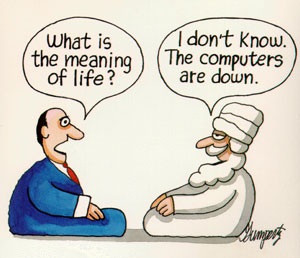 Atheists are often confronted with a line of questioning revolving around what provides purpose and meaning to their lives. What do atheists believe in? What gives their life purpose? What gives their life meaning? Typically it is asserted that because an atheist does not believe in a god, their life has no purpose and no meaning.
For starters, it is diabolical to assert that purpose and meaning can only come from believing in a god. Travelling down this road expects you to disregard all other pursuits in your life as lacking purpose and as essentially meaningless.
Atheists have two things in common, they don't believe in any gods and just like almost all of humanity, their lives have purpose and meaning. Where their purpose and meaning is derived from can be wild and can be varied. What their opinions and positions are on subjects are also similarly wild and varied.
 Some may draw purpose and meaning rallying against the ridiculous notion of religion and the mega rich mega churches that benefit. Some may draw purpose and meaning in composition of music and art. To not draw only positive associations, some may draw purpose and meaning from violence and the less digestible aspects of human behaviour.
For me personally, purpose can be derived from many and varied places quite easily without enacting belief in a god. Family gives meaning, creativity gives meaning, work gives meaning and so it seems, life itself gives meaning.
A theist who believes in god, feels they derive purpose and meaning from a god. Congratulations, they assert possession of a gift that non-believers can not experience, or so they say. A positive assertion that the theist has purpose and meaning to life whereas those non-believers cannot and/or do not. Fairly typical of a theist to gravitate towards positivity in their position.
Now address a simple question, where does a hypothetical god derive purpose and meaning from? A god is usually at the top of the spiritual food chain and answers to nobody. Using the same logic as applied to atheists, a god and it's existence has no purpose and no meaning.
- Atheists do not believe in a god = No meaning or purpose to life.
- A god cannot have belief in a higher being = No meaning or purpose to life.
These two statements arrive at the same result because atheists reject higher beings and a god has no higher being to worship. They both do not worship higher beings, therefore neither has purpose or meaning to their existence. However, in reality, a god, the idea of a god, or whatever it is, falls into the same category as an atheist. Purpose and meaning are derived from many and varied places, internally and externally.
 |
| Meaning Without God - Rabbits |
As a side note, what exactly is the purpose and meaning of the existence of a god? If a god is everything outside of it's creation, the bits outside the universe we live in, what is the point of a god being there? A theist worships a god and finds purpose and meaning, but what is the purpose and meaning of a god?
Simplistically, could a theist derive the same kind of purpose and meaning from the worship of a dictator?
In conclusion, the assertion that an atheist, who does not derive purpose and meaning from god, has no purpose or meaning to their life, is absurd.
Friday, November 11, 2011
Miraculous Transformations
A Miraculous Transformation from Atheist to Christian
It is always interesting to read about a miraculous transformation from an atheist (a word that should not exist) to a christian, or any other religious denomination.
I read a letter to an editor of Daily Lobo by Michael Sandoval. Below is an excerpt.
It is great that Michael has a new found confidence, but it is actually depressing that he arrogantly thought he knew everything when he was an atheist. Sure, I can understand having confidence in your world view and providing good reason and justification for your world view, but nobody knows everything and thinking that you do is dishonest and absurd. Nobody can know everything.
I think that accepting the fact that you don't know and can't know everything is similar to delegating the explanation to a god or a story in a book. It amounts to a mental offload, acceptance and maybe a relief that there are things and problems you don't need to know about or solve. The difference being that putting a god into the equation only complicates the situation and you are in exactly the same position as before. You still don't know everything but you've delegated to an imaginary god that still doesn't explain anything.
On a slightly similar note, I conducted a mental exercise, sat in a room and offloading my problems and issues to an imaginary entity, say, a flying spaghetti monster. I externalized my thoughts and put the burden on something else. Sure, it is kind of interesting, the flying spaghetti monster wasn't aware I did it, but I've mentally conned myself into not facing up to my problems and issues. I've effectively done nothing to address the issues. Back to reality, I admit to myself that I can't deal with or explain a situation and go and get some assistance. No need to invoke a imaginary entity.
I'm still surprised that people invoke a god and then everything suddenly makes sense to them. Basically conducting a mental con job on themselves and not actually providing any answers or explanations for anything. Basically it boils down to honesty. Either deal with and accept the fact that you don't know everything or dishonestly invoke an imaginary god that explains everything without explaining anything. Any position, other than that of honesty, is absurd.
It is always interesting to read about a miraculous transformation from an atheist (a word that should not exist) to a christian, or any other religious denomination.
I read a letter to an editor of Daily Lobo by Michael Sandoval. Below is an excerpt.
I know I’ll get flak for this but I’m strong in my beliefs, and I honestly don’t care what you have to say. Becoming a Christian was the best thing that has ever happened to me, next to falling in love with my fiancée. I found a new life and all of a sudden everything seemed like it made sense. Keep in mind that I was an atheist before this happened 2 or 3 months ago. I felt that up until then I knew everything there was to know and since I felt strong in my knowledge, there was no need for religion. I couldn’t have been more wrong.Michael was an atheist who felt he knew everything there was to know. He then became a christian and all of a sudden everything made sense.
It is great that Michael has a new found confidence, but it is actually depressing that he arrogantly thought he knew everything when he was an atheist. Sure, I can understand having confidence in your world view and providing good reason and justification for your world view, but nobody knows everything and thinking that you do is dishonest and absurd. Nobody can know everything.
I think that accepting the fact that you don't know and can't know everything is similar to delegating the explanation to a god or a story in a book. It amounts to a mental offload, acceptance and maybe a relief that there are things and problems you don't need to know about or solve. The difference being that putting a god into the equation only complicates the situation and you are in exactly the same position as before. You still don't know everything but you've delegated to an imaginary god that still doesn't explain anything.
On a slightly similar note, I conducted a mental exercise, sat in a room and offloading my problems and issues to an imaginary entity, say, a flying spaghetti monster. I externalized my thoughts and put the burden on something else. Sure, it is kind of interesting, the flying spaghetti monster wasn't aware I did it, but I've mentally conned myself into not facing up to my problems and issues. I've effectively done nothing to address the issues. Back to reality, I admit to myself that I can't deal with or explain a situation and go and get some assistance. No need to invoke a imaginary entity.
I'm still surprised that people invoke a god and then everything suddenly makes sense to them. Basically conducting a mental con job on themselves and not actually providing any answers or explanations for anything. Basically it boils down to honesty. Either deal with and accept the fact that you don't know everything or dishonestly invoke an imaginary god that explains everything without explaining anything. Any position, other than that of honesty, is absurd.
When You Are Born
When You Are Born
I was having a discussion recently about the word "atheist". It is a label that many non-religious people take on.
I've heard it mentioned that the word "atheist" is interesting because it describes what you are not. For example, being an atheist means you are not a believer in any gods.
Strangely, the existence of the word "atheist" insinuates that being religious is the default position and an atheist somehow chooses to not believe. Of course this is absurd.
Imagine that when you are born, you are born religious. Many problems arise from this scenario. What religion are you? Are you religious in the Christian sense? Are you religious in the Muslim sense? Maybe it is a nondescript religion you are born into?
Typically your religion is defined by your parents or where you are born but moving on from this point, when presented with Christianity and Islam as options, if you don't choose Christianity but choose Islam instead, do you now identify as a non-Christian? No. You identify as a Muslim. This is a positive association. You chose, or were indoctrinated into, Islam. "I am a Muslim", you say proudly.
Of course, the idea of being born religious is really absurd. No-one is born religious. We are exposed to religion as we grow up. As mentioned before, typically this exposure is from our parents or the religious culture of the country or society we are born into. In reality, everyone is an atheist when they are born. The default position is no religious belief and no belief in any gods. So by extension, the word atheist does not need to be defined or even exist.
Religion is not a position you must accept and it is not something that you reject either. If the Christian religion is presented to you, you are not rejecting it if you don't become a Christian.
Typically this is described in terms of a hobby. Not collecting stamps, being a non-stamp collector, is not considered a hobby. I collected stamps when I was a kid, but I chose to collect stamps. Given the myriad of options, I could have collected coins but I wouldn't define myself as a non-stamp collector, or a non-pen collector.
A positive association with a religion or a belief in a god or gods should come with a label. You have chosen to become religious or believe in a god or gods. You can therefore say, "I am a theist" or "I am a Christian" or "I am a Muslim" etc.
Defining a person by what they do not positively associate with, is absurd. Furthermore, any idea that you are born religious is also absurd.
I was having a discussion recently about the word "atheist". It is a label that many non-religious people take on.
I've heard it mentioned that the word "atheist" is interesting because it describes what you are not. For example, being an atheist means you are not a believer in any gods.
Strangely, the existence of the word "atheist" insinuates that being religious is the default position and an atheist somehow chooses to not believe. Of course this is absurd.
Imagine that when you are born, you are born religious. Many problems arise from this scenario. What religion are you? Are you religious in the Christian sense? Are you religious in the Muslim sense? Maybe it is a nondescript religion you are born into?
Typically your religion is defined by your parents or where you are born but moving on from this point, when presented with Christianity and Islam as options, if you don't choose Christianity but choose Islam instead, do you now identify as a non-Christian? No. You identify as a Muslim. This is a positive association. You chose, or were indoctrinated into, Islam. "I am a Muslim", you say proudly.
Of course, the idea of being born religious is really absurd. No-one is born religious. We are exposed to religion as we grow up. As mentioned before, typically this exposure is from our parents or the religious culture of the country or society we are born into. In reality, everyone is an atheist when they are born. The default position is no religious belief and no belief in any gods. So by extension, the word atheist does not need to be defined or even exist.
Religion is not a position you must accept and it is not something that you reject either. If the Christian religion is presented to you, you are not rejecting it if you don't become a Christian.
Typically this is described in terms of a hobby. Not collecting stamps, being a non-stamp collector, is not considered a hobby. I collected stamps when I was a kid, but I chose to collect stamps. Given the myriad of options, I could have collected coins but I wouldn't define myself as a non-stamp collector, or a non-pen collector.
A positive association with a religion or a belief in a god or gods should come with a label. You have chosen to become religious or believe in a god or gods. You can therefore say, "I am a theist" or "I am a Christian" or "I am a Muslim" etc.
Defining a person by what they do not positively associate with, is absurd. Furthermore, any idea that you are born religious is also absurd.
Wednesday, November 9, 2011
Atheists : Compelling and Intellectually Challenging
Atheists : Compelling and Intellectually Challenging
I have written previously about becoming bored with the same arguments and word games employed by theists.
In stark contrast, I am continually surprised by the compelling and intellectually challenging positions and analysis of the bible and religion by atheists. Today I read a blog post highlighting a comment made by Stephen Fry in regards to "What Knowledge Did The Apple Bring".
Stephen Fry has only recently appeared in my readings regarding religion and I am learning that I need to read more about him and read more of his writings. The Four Horsemen often come to mind in regards to atheism, but in my mind, a fifth has now entered. Stephen Fry, I welcome your insights and brilliance.
With this in mind, I have observed that atheists are continually asking the difficult questions and critically evaluating the bible and religion. Atheists give respect only where it is earned and deserved. Stephen, as an atheist, asks some compelling questions and draws some reasonable conclusions about the bible and the absurdity of the genesis story.
I often to wonder why theists aren't applying the same critical analysis to the bible. An intelligent, and intellectually honest adult should be able to see straight through the bible. I think it all comes back to a the scary reality of a breakdown in their world view. The inability to let go of an unfortunate lie they've been told all of their lives. Everything they've believed about god and the world hinges on these illogical and inconsistent stories, fables and parables. They just can't let go. Defending the only position you know.
As an atheist and a skeptic, I want to be challenged. I want my worldview to be elastic, to be convinced of a compelling argument, to accept that an idea or opinion I have is wrong and to move on and learn about the next big thing. Clinging stubbornly to old ways and old ideas, like a mental Luddite, is absurd.
I have written previously about becoming bored with the same arguments and word games employed by theists.
In stark contrast, I am continually surprised by the compelling and intellectually challenging positions and analysis of the bible and religion by atheists. Today I read a blog post highlighting a comment made by Stephen Fry in regards to "What Knowledge Did The Apple Bring".
Stephen Fry has only recently appeared in my readings regarding religion and I am learning that I need to read more about him and read more of his writings. The Four Horsemen often come to mind in regards to atheism, but in my mind, a fifth has now entered. Stephen Fry, I welcome your insights and brilliance.
With this in mind, I have observed that atheists are continually asking the difficult questions and critically evaluating the bible and religion. Atheists give respect only where it is earned and deserved. Stephen, as an atheist, asks some compelling questions and draws some reasonable conclusions about the bible and the absurdity of the genesis story.
I often to wonder why theists aren't applying the same critical analysis to the bible. An intelligent, and intellectually honest adult should be able to see straight through the bible. I think it all comes back to a the scary reality of a breakdown in their world view. The inability to let go of an unfortunate lie they've been told all of their lives. Everything they've believed about god and the world hinges on these illogical and inconsistent stories, fables and parables. They just can't let go. Defending the only position you know.
As an atheist and a skeptic, I want to be challenged. I want my worldview to be elastic, to be convinced of a compelling argument, to accept that an idea or opinion I have is wrong and to move on and learn about the next big thing. Clinging stubbornly to old ways and old ideas, like a mental Luddite, is absurd.
Sunday, November 6, 2011
Apologetic Word Games
Apologetic Word Play and Other Games
I freely admit that I am starting to get bored of the same arguments and word games employed by religious apologists. In defense of the creator of the universe, the apparently all knowing and almighty, apologists present us with broken arguments, flawed definitions and unknowable assertions.
An apologist might apply the concept of cause to the universe. Apparently god caused the universe to exist. In a typical example of a broken argument, turn to the next page and be told that god is eternal and just existed. An entity so complex, and able to create the universe, just exists. Apologists assert this as fact.
I ask what is on the outside of the universe, the container for all life and matter? In theory, nothing. In reality, who knows? Where exactly did god happen to exist before the universe existed? The apologist will always make a special "look the other way" case for their own absurd arguments.
Word games are also employed by apologists. Plug a word like "atheist" into Google or any online dictionary and choose the definition that suits your argument. An apologist will assert that an atheist knows there is no god. Sure, some atheist assert there is no god, but atheism is about a lack of belief in gods, not knowledge. Truly, no-one can know if there is or isn't a god. A theist can believe all they want. An atheist can disbelieve all they want. No-one has proven that god does or doesn't exist. It is far more intellectually honest to choose atheism.
Typically a theist would play the "you can't prove god doesn't exist" card. Effectively this argument is worth walking away from at this point. No-one can disprove the existence of a unicorn, Santa or the tooth fairy and no-one would be dishonest enough to assert that they do exist. Even if we could explain every physical aspect of the entire universe, a theist would move god into an unverifiable and unknowable plane in defense of this absurd argument.
In a typically circular fashion, the idea of god, that was constructed by men, an idea formed in the mind, meets it's final death throes in the mind. Essentially in the form of tired and often repeated arguments from apologists.
Apologists remind me of someone who cannot admit they are wrong. Based on reality and the evidence it is dishonest to say "I read this book. I have the answers. I am right". Instead, the apologist continues to argue and grapple with obscurities and absurdities which are unnecessary if they just said they didn't know.
Of course, I don't know if I'm right, but reality and the evidence are all pointing in the same direction. The arguments presented by apologists are boring, circular, flawed, unknowable and absurd.
I freely admit that I am starting to get bored of the same arguments and word games employed by religious apologists. In defense of the creator of the universe, the apparently all knowing and almighty, apologists present us with broken arguments, flawed definitions and unknowable assertions.
An apologist might apply the concept of cause to the universe. Apparently god caused the universe to exist. In a typical example of a broken argument, turn to the next page and be told that god is eternal and just existed. An entity so complex, and able to create the universe, just exists. Apologists assert this as fact.
I ask what is on the outside of the universe, the container for all life and matter? In theory, nothing. In reality, who knows? Where exactly did god happen to exist before the universe existed? The apologist will always make a special "look the other way" case for their own absurd arguments.
Word games are also employed by apologists. Plug a word like "atheist" into Google or any online dictionary and choose the definition that suits your argument. An apologist will assert that an atheist knows there is no god. Sure, some atheist assert there is no god, but atheism is about a lack of belief in gods, not knowledge. Truly, no-one can know if there is or isn't a god. A theist can believe all they want. An atheist can disbelieve all they want. No-one has proven that god does or doesn't exist. It is far more intellectually honest to choose atheism.
Typically a theist would play the "you can't prove god doesn't exist" card. Effectively this argument is worth walking away from at this point. No-one can disprove the existence of a unicorn, Santa or the tooth fairy and no-one would be dishonest enough to assert that they do exist. Even if we could explain every physical aspect of the entire universe, a theist would move god into an unverifiable and unknowable plane in defense of this absurd argument.
In a typically circular fashion, the idea of god, that was constructed by men, an idea formed in the mind, meets it's final death throes in the mind. Essentially in the form of tired and often repeated arguments from apologists.
Apologists remind me of someone who cannot admit they are wrong. Based on reality and the evidence it is dishonest to say "I read this book. I have the answers. I am right". Instead, the apologist continues to argue and grapple with obscurities and absurdities which are unnecessary if they just said they didn't know.
Of course, I don't know if I'm right, but reality and the evidence are all pointing in the same direction. The arguments presented by apologists are boring, circular, flawed, unknowable and absurd.
Sunday, September 25, 2011
Dear Professor Dawkins: Science Is a Servant of Truth, Not Atheism
Dear Professor Dawkins: Science Is a Servant of Truth, Not Atheism
All credible scientists freely admit that they do not know the answer as to how life arose. They can hypothesize all they want. As Dawkins clearly says, “I told you I don’t know” followed by “No, No, nor does anyone else”. Further to this, Dawkins would never use Darwinian evolution to explain how life arose. This would be a big mistake.
Dawkins really has no burden of proof unless he makes a claim. The answers provided are perfectly reasonable considering the poor questions asked by Stein.
Contrast this with the opinion of a theist, “I’ve read the Bible, the Christian God created us”. No-one in the history of Christianity has been able to provide evidence of God or that he created us. Meanwhile, science continually disproves the fantastical stories of the Bible and continues to close the gaps where theists place their Gods. Atheism becomes more powerful with the ally of science.
Smiley faces don’t make themselves, computers don’t make themselves and by extension, God didn’t make itself. They are all man made as far as we can tell and prove.
Who created God, how did life arise and what is wrong with saying, “I don’t know”, and using science to figure it out.
++++
Science knows nothing and expects evidence for everything. Religion knows everything and expects evidence of nothing – Anonymous
Comment on post by Rabbi Moshe Averick
All credible scientists freely admit that they do not know the answer as to how life arose. They can hypothesize all they want. As Dawkins clearly says, “I told you I don’t know” followed by “No, No, nor does anyone else”. Further to this, Dawkins would never use Darwinian evolution to explain how life arose. This would be a big mistake.
Dawkins really has no burden of proof unless he makes a claim. The answers provided are perfectly reasonable considering the poor questions asked by Stein.
Contrast this with the opinion of a theist, “I’ve read the Bible, the Christian God created us”. No-one in the history of Christianity has been able to provide evidence of God or that he created us. Meanwhile, science continually disproves the fantastical stories of the Bible and continues to close the gaps where theists place their Gods. Atheism becomes more powerful with the ally of science.
Smiley faces don’t make themselves, computers don’t make themselves and by extension, God didn’t make itself. They are all man made as far as we can tell and prove.
Who created God, how did life arise and what is wrong with saying, “I don’t know”, and using science to figure it out.
++++
Science knows nothing and expects evidence for everything. Religion knows everything and expects evidence of nothing – Anonymous
Friday, September 16, 2011
Reverse Engineering - Science vs Bible
Reverse engineering is a term you hear quite often in the world of Information Technology. It is usually undertaken to figure out how something works, specifically without knowing the techniques or technologies used to produce the product or software in question. See Wikipedia for more detail on Reverse Engineering.
Science uses this style of technique quite frequently. Nature, in all of it's beauty, is observed and pulled apart in an effort to understand how it works. In many cases, astounding advances in understanding are made. Bio-mimicry in particular uses these observations from nature to produce technological advances by trying to replicate nature.
With this in mind, science only knows what it knows. Highly educated hypotheses may be formed but science doesn't pretend to know the answers.
On the other hand, the reverse engineering techniques employed by the writers of the bible are the polar opposite of science. They observe a particular phenomena and write it up as an act or sign from god. In itself this is no big deal as many works of fiction describe fantastical scenarios and phenomena. The problem here is that the bible and the purveyors of the bible, present this as fact.
When a rainbow forms in the sky, apparently it is the sign of the covenant from God (Genesis 9:8-16).
Maybe it is a sign from God, but the verifiable and reproducible facts are that it is light passing through raindrops. No need to invoke the supernatural, unlike the scientifically ignorant writers of the bible.
Science, rather than jumping to fantastical conclusions and unsubstantiated statements of fact, will reverse engineer nature through observation and experiment to find the real truth. In the face of the real truth, believing the fantastical stories and unsubstantiated statements made in the bible is just absurd.
Science uses this style of technique quite frequently. Nature, in all of it's beauty, is observed and pulled apart in an effort to understand how it works. In many cases, astounding advances in understanding are made. Bio-mimicry in particular uses these observations from nature to produce technological advances by trying to replicate nature.
With this in mind, science only knows what it knows. Highly educated hypotheses may be formed but science doesn't pretend to know the answers.
On the other hand, the reverse engineering techniques employed by the writers of the bible are the polar opposite of science. They observe a particular phenomena and write it up as an act or sign from god. In itself this is no big deal as many works of fiction describe fantastical scenarios and phenomena. The problem here is that the bible and the purveyors of the bible, present this as fact.
When a rainbow forms in the sky, apparently it is the sign of the covenant from God (Genesis 9:8-16).
Maybe it is a sign from God, but the verifiable and reproducible facts are that it is light passing through raindrops. No need to invoke the supernatural, unlike the scientifically ignorant writers of the bible.
Science, rather than jumping to fantastical conclusions and unsubstantiated statements of fact, will reverse engineer nature through observation and experiment to find the real truth. In the face of the real truth, believing the fantastical stories and unsubstantiated statements made in the bible is just absurd.
Monday, August 29, 2011
Quote by Robert G. Ingersoll
Quote by Robert G. Ingersoll
"The notion that faith in Christ is to be rewarded by an eternity of bliss, while a dependence upon reason, observation, and experience merits everlasting pain, is too absurd for refutation, and can be believed only by that unhappy mixture of insanity and ignorance called 'faith.'" -- Robert G. Ingersoll
"The notion that faith in Christ is to be rewarded by an eternity of bliss, while a dependence upon reason, observation, and experience merits everlasting pain, is too absurd for refutation, and can be believed only by that unhappy mixture of insanity and ignorance called 'faith.'" -- Robert G. Ingersoll
Tuesday, August 23, 2011
The Christian Bible - Undeserved Privilege
The Christian Bible - Undeserved Privilege
It seems only fair that I should try and understand the religious point of view, so what better way than to read the Christian Bible. I've chosen the Christian Bible as many people confidently explain that Australian society is based on Christian values and I've grown up in Australia.
Staring at the cover, you must admit, the Bible is loaded with hype. Psychological, historical and societal hype. Psychological hype, as apparently it is the one true word and nobody can deny it. Historical hype, as apparently all of the stories are true, without a doubt. Societal hype, as apparently our morals and society are built on it's teachings, without question.
If you ignore all of the hype, the Bible is just another work of literature. Under a modern barometer the stories are interesting in a curious kind of way, just like any other literature from the numerous religions and cults that are now defunct, or the latest incarnation of the Harry Potter series.
Literature throughout history has attempted to express truths, stories and teachings through imagery of magicians, fairies, dragons, vampires and rainbow serpents, among others. Any reasonable person easily accepts this literature as fiction, accepts the fantasy, enjoys the story, and moves on.
Turning our gaze again towards the Bible, the truths, stories and teachings using imagery of virgin births, talking snakes, a man living inside a whale, zombies and unicorns, among others, are routinely accepted as fact by Christians even after they reject other fantastical literature as fiction. The Bible is divinely inspired they explain with confidence, dishonesty and self delusion.
John W. Loftus of Debunking Christianity is world famous for his Outsider Test for Faith. The OTF applies in the context of literature just as well as any other. A Christian effortlessly rejects the fantastical truths, stories and teachings in other non-Bible literature, but easily accepts similar fantastical claims within the Bible. This same effortless rejection seems to apply to other religious texts such as the Koran, the Book of Mormon and Greek Mythology stories.
It seems only fair that I should try and understand the religious point of view, so what better way than to read the Christian Bible. I've chosen the Christian Bible as many people confidently explain that Australian society is based on Christian values and I've grown up in Australia.
Staring at the cover, you must admit, the Bible is loaded with hype. Psychological, historical and societal hype. Psychological hype, as apparently it is the one true word and nobody can deny it. Historical hype, as apparently all of the stories are true, without a doubt. Societal hype, as apparently our morals and society are built on it's teachings, without question.
If you ignore all of the hype, the Bible is just another work of literature. Under a modern barometer the stories are interesting in a curious kind of way, just like any other literature from the numerous religions and cults that are now defunct, or the latest incarnation of the Harry Potter series.
Literature throughout history has attempted to express truths, stories and teachings through imagery of magicians, fairies, dragons, vampires and rainbow serpents, among others. Any reasonable person easily accepts this literature as fiction, accepts the fantasy, enjoys the story, and moves on.
Turning our gaze again towards the Bible, the truths, stories and teachings using imagery of virgin births, talking snakes, a man living inside a whale, zombies and unicorns, among others, are routinely accepted as fact by Christians even after they reject other fantastical literature as fiction. The Bible is divinely inspired they explain with confidence, dishonesty and self delusion.
John W. Loftus of Debunking Christianity is world famous for his Outsider Test for Faith. The OTF applies in the context of literature just as well as any other. A Christian effortlessly rejects the fantastical truths, stories and teachings in other non-Bible literature, but easily accepts similar fantastical claims within the Bible. This same effortless rejection seems to apply to other religious texts such as the Koran, the Book of Mormon and Greek Mythology stories.
Accepting the Bible, while rejecting other literature with the same flaws, is hypocritical, absurd and intellectually dishonest. Apply the Outsider Test for Faith, embrace honesty and understand that the Christian Bible receives undeserved privilege.
End Note:
To further quote John Loftus, "There isn't a trace of a divine author behind the pages in the Bible. Everything in it is more credibly understood as the musings of ancient pre-scientific superstitious barbaric agency detectors."
Tuesday, July 26, 2011
Einstein and God
Einstein and God
There seems an endless fascination among the religious to quote Einstein and cite his references to God. They quote Einstein to leverage his scientific brilliance and by extension, justify the existence of a God and justify why people of lesser intelligence should believe. They insinuate that If Einstein believed there to be a God, surely he is smart enough to know better, therefore God exists and so everyone should believe. This assumes that Einstein, when using the word God, meant exactly the same definition of God that a believer has in their mind. Even believers can't agree on the true definition of God, so what are the chances of it matching what Einstein meant. Probably low to none.
If we take a look back over the history of science and scientists who believed in God, we could find many such examples. Brilliant minds, observing and discovering brilliance in science, nature, mathematics and physics to name just a few. For each observation and/or discovery, they formed an extensive hypothesis, which turned into a theory and is eventually accepted as fact through application of scientific method. This theory is peer reviewed, critically analysed, verifiable and backed up by evidence. The discoveries, hypothesis and theories put forward by Einstein are continually challenged and are proven correct on a daily basis via their real world application and experiment.
Now turn your gaze towards Einstein in regards to the idea of God. It is essentially irrelevant who or what posits the existence of God. A layman, a builder, a computer programmer or a brilliant scientist can all state their belief in God but, as certain as the passing of time, the idea and existence of God has failed peer review, has not survived critical analysis, cannot be verified and is not backup up by evidence. Ignore this at your peril. God is not even a theory in the eyes of the scientific method. At most it is a highly unsubstantiated and unverifiable hypothesis and as such, Einstein, as with all others before him, have come no closer to proving God, even if that is what he meant.
The scientific method is consistent. It continues to provide evidence beyond doubt that a majority of the Bible stories didn't happen and easily dismisses poorly presented, inconsistent and unverifiable claims that God exists. Through all of the hard work, it continues the confirm the theory of evolution, the theory of gravity, the theory of special relativity, theory of general relativity, mathematics, general physics and quantum physics, to name a few. The gaps for God to sit in are constantly being removed by the scientific method to such an extent that theists now move God outside of the physical world, to other realms not observable or available for analysis.
This puts a theist in a very difficult position. Place confidence in Einstein to prove and justify the existence of a God but on the other hand, deny the scientific method that continually invalidates and dismisses the foundation documents, stories within the Bible and, of course, God.
Using Einstein to justify a God, or your belief in God, is absurd.
Wednesday, July 20, 2011
Who created the Creator?
Who created the Creator?
When discussing matters of the existence of the universe, a theist might be compelled to state “God created the Universe”. They easily accept this as fact and shut down their brain having satisfied their requirements for an answer. Others may ask, “Who created the Creator?”. It is such an obvious question to ask and is just like a child asking “Why?”.
I’ve asked this question and could ask the same question into infinity and never have an answer. Even if we are living in a computer simulation, the creator of the computer simulation would have to come from somewhere as well. Up until this point, we have no answers for how the Universe got here and pretending that a book has the only answer is narrow minded and short sighted.
Even well substantiated theories like the Big Bang, are generally outside of my understanding. I can’t grasp true nothingness. Sure, I can understand the idea of a black void or a vacuum, but these concepts represent something. A black void exists and so does a vacuum. However, given the evidence, a Big Bang most likely did happen and is a theory based on what we can and have observed. Does anyone know what came before, or existed before the Big Bang? No. Scientists constantly hypothesis and discuss possibilities but no-one truly knows. There are no absolutes.
Those, who reject the Big Bang theory explain that something can’t come from nothing. It does sound implausible but what is more implausible, the idea that God has always existed and he (?) created the Universe or that the Universe just came into existence? A theist expects the evidence to be presented to back up the Big Bang theory but requires no such evidence for their own position. Apparently they just know that God created the Universe.
It is absurd to suggest that a God, who is all powerful and all knowing, is sufficiently complex to create a universe and everything within it, listens to prayers and meddles with physical reality as needs be, just exists and has always existed. How about coming down from your theistic high horse and saying “I don’t know”.
You don’t know, I don’t know, the best minds in the world don’t know. If you think you know, you are deluded or are wrong.
When discussing matters of the existence of the universe, a theist might be compelled to state “God created the Universe”. They easily accept this as fact and shut down their brain having satisfied their requirements for an answer. Others may ask, “Who created the Creator?”. It is such an obvious question to ask and is just like a child asking “Why?”.
I’ve asked this question and could ask the same question into infinity and never have an answer. Even if we are living in a computer simulation, the creator of the computer simulation would have to come from somewhere as well. Up until this point, we have no answers for how the Universe got here and pretending that a book has the only answer is narrow minded and short sighted.
Even well substantiated theories like the Big Bang, are generally outside of my understanding. I can’t grasp true nothingness. Sure, I can understand the idea of a black void or a vacuum, but these concepts represent something. A black void exists and so does a vacuum. However, given the evidence, a Big Bang most likely did happen and is a theory based on what we can and have observed. Does anyone know what came before, or existed before the Big Bang? No. Scientists constantly hypothesis and discuss possibilities but no-one truly knows. There are no absolutes.
Those, who reject the Big Bang theory explain that something can’t come from nothing. It does sound implausible but what is more implausible, the idea that God has always existed and he (?) created the Universe or that the Universe just came into existence? A theist expects the evidence to be presented to back up the Big Bang theory but requires no such evidence for their own position. Apparently they just know that God created the Universe.
It is absurd to suggest that a God, who is all powerful and all knowing, is sufficiently complex to create a universe and everything within it, listens to prayers and meddles with physical reality as needs be, just exists and has always existed. How about coming down from your theistic high horse and saying “I don’t know”.
You don’t know, I don’t know, the best minds in the world don’t know. If you think you know, you are deluded or are wrong.
Subscribe to:
Posts (Atom)